
Largo Previous-Resident Sources
No single roll names everyone who occupied a Largo home. Start with the current parcel card, then move backward through recorded deeds. The owner trail can be tied to household evidence from the 1912 regional directory, the 1910 Largo census extraction, the 1926 Sanborn atlas, obituaries, probate files, and funeral-home records. Each source answers a different question. A deed identifies a transfer between owners, while a directory or census may place people at an address who never held title.
| Source | Years It Covers | Where Held | What It Shows |
|---|---|---|---|
| Official Records index | Index from 1957; viewable images from 1970 | Pinellas Clerk | Grantors, grantees, dates, book and page |
| Property parcel card | Current roll and recorded sales history | Pinellas Property Appraiser | Owner, site and mailing address, legal description |
| Regional city directory | 1912 confirmed for Largo | Pinellas Genealogy Society | Named household entries and street addresses |
| Census extracts | Largo 1910; Bayview 1920 | Pinellas Genealogy Society | People grouped in households |
| Sanborn atlas | 1926, four sheets | Library of Congress | Building footprint, use and construction context |
For a recent transfer, the Property Appraiser parcel history gives the fastest starting name and legal description. The clerk then supplies the recorded instruments. For an early twentieth-century question, begin with the genealogy collections, but keep the deed chain as the backbone. The online index and image dates are cutoffs, not the start of local record keeping. Older material may require the clerk, microfilm, archives, or a written research request.
Start Largo Previous-Resident Records
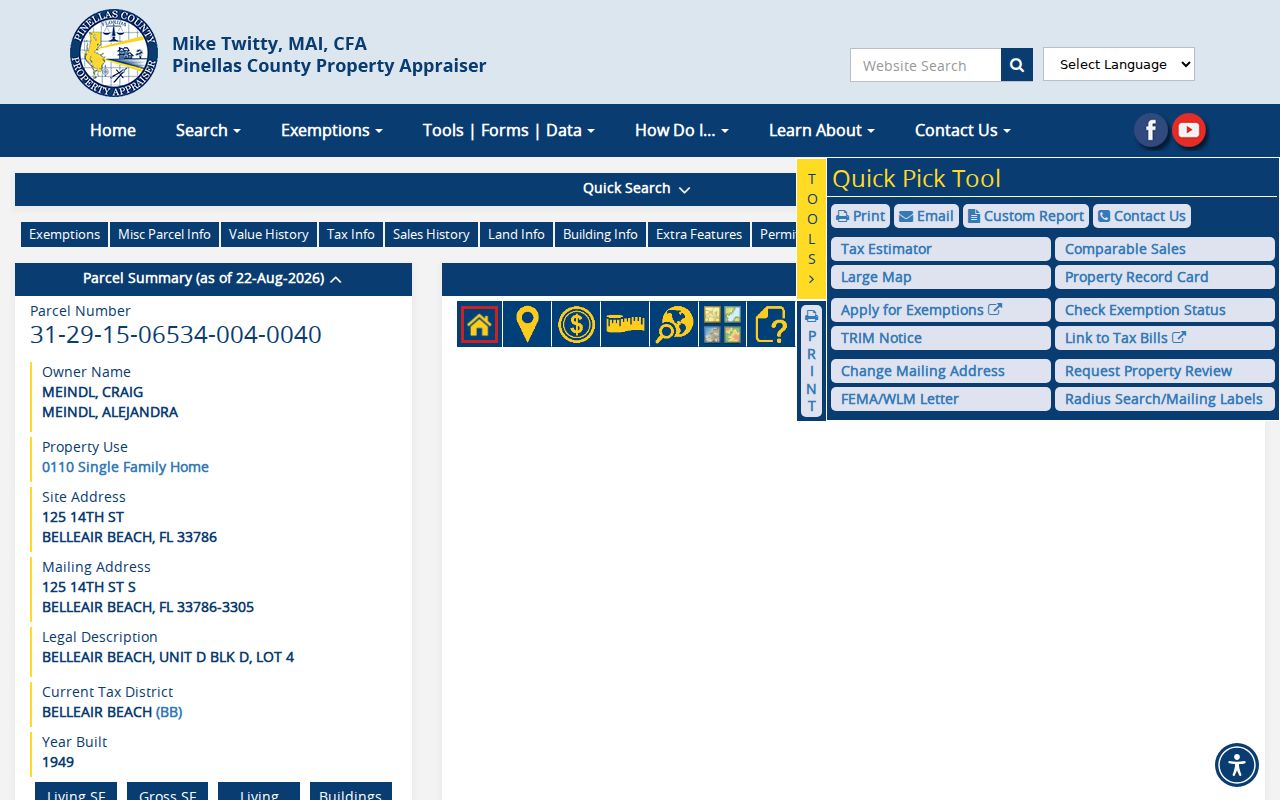
The parcel card separates the physical site address from the owner's mailing address. That distinction matters. A mailing address elsewhere does not prove that the Largo house stood empty, and matching site and mailing addresses do not establish every household member. Use the parcel ID and legal description as stable identifiers when street wording changes.
The card's book-and-page links can point directly toward a recorded deed. Sales history can also flag which transfer deserves review first. A price, date, or owner field is an index clue, not proof by itself. Open the underlying instrument and confirm the names, legal description, and recording data.
See the Pinellas Property Appraiser Quick Search before comparing the sample parcel image below. The captured parcel history shows how one Largo property organizes identifiers and transfers.
Largo Previous-Resident Record Cutoffs
The Pinellas Official Records portal has an online index beginning in 1957. Legally viewable official-record images are online from 1970 forward. Those two dates are easy to confuse. A 1960 index hit may exist even when its document image is not available through the same online route.
Pinellas County records begin with the county's creation in 1912. If the chain reaches earlier, Largo was still within Hillsborough County. Search the prior jurisdiction rather than assuming a missing result means no deed exists. For inaccessible years or images, contact Recording Services, inspect microfilm or deed books, or route a request through the clerk. Florida Public Records Law provides a request path, subject to exemptions.
Note: Keep a research log with every spelling, instrument number, book, page, and jurisdiction checked.
Search Largo Past-Resident Deeds
The official-record index works by party name, document type, and date rather than by a modern street address alone. Once the parcel card supplies a deed reference, note every person or entity named in the instrument. Search the seller as an earlier buyer, and narrow the date only after a broad name search reveals the pattern.
Trust the legal description more than spelling. A middle initial may appear in one deed and vanish in the next. A trust or company may interrupt a personal-name chain. Mortgages, satisfactions, liens, and plats can add dates, but they are not all conveyances. Keep the deed that transferred title distinct from records that merely affected the parcel.
If a portal result offers an index entry but no image, request the instrument by its recorded reference. The clerk's office remains the custodian. A portal outage or image cutoff changes the access channel, not the underlying chain.
Trace Largo Past Owners
A chain of title is the sequence of recorded transfers for the same land. Work from the known present backward. The current grantee, the buyer receiving title, usually appears as a grantee in the purchase deed. The grantor is the seller transferring an interest. Names may vary, so keep the parcel's legal description beside every search.
- Find the current owner, parcel ID, legal description, sales line, and deed book/page on the Property Appraiser record.
- Open the latest purchase deed in the clerk's index. Confirm that its legal description matches the parcel.
- Take the seller's name from that deed and search for that person or entity as a grantee in an earlier purchase.
- Repeat the handoff. Record dates and instrument references, and test name variants without losing the land description.
- At the online cutoff, move to clerk-held books, microfilm, archives, or the earlier county's records.
- Grantor and grantee
- The grantor transfers an interest; the grantee receives it.
- Chain of title
- The linked series of ownership transfers for one parcel.
- Legal description
- The land description in a deed, often more durable than a postal street address.
Map Earlier Largo Residents
Historic maps test whether the same street number pointed to the same building. The Library of Congress holds a freely digitized 1926 Largo Sanborn fire-insurance atlas with four sheets. Sanborn maps describe structures and uses; they do not identify every occupant. Pair the map with a directory or census entry instead of reading a household into a building outline.
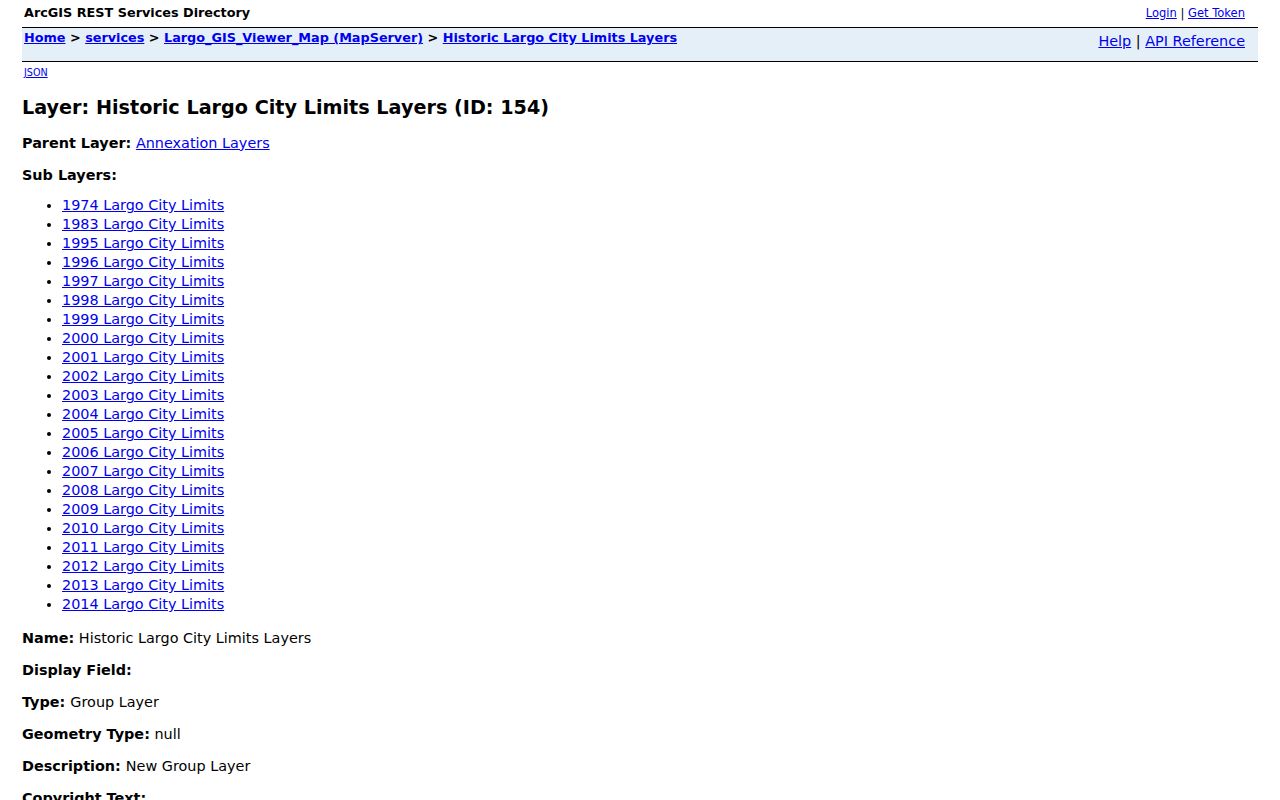
Municipal boundaries add another trap. Largo's GIS includes selected historic city-limit layers, while a postal Largo address may sit outside the city. Check the historic Largo limits layer when choosing a custodian or interpreting an old permit. The image below shows the official layer endpoint used to compare changing jurisdiction.
Pair Largo Resident Directory Years
The cleanest early Largo pairing uses the 1910 census extraction, the 1912 regional directory, and the 1926 map. Begin with a surname in the directory, capture its address exactly, and check the abbreviation key before expanding any occupation or relationship mark. Then test the household in the earlier census. A census is organized by enumeration district, the geographic area assigned to a census taker, so an address may require district work rather than a simple name search.
- Copy the 1912 directory entry exactly, including initials, street wording, and any spouse or work notation.
- Search the 1910 Largo census extraction for the same surname and close variants.
- Compare ages, relatives, work, and nearby households without forcing a match.
- Use the 1926 Sanborn sheet to test the building and block context.
- Return to deeds and probate files for evidence that links the person to the land.
The gap between sources matters. A person could move, a house number could change, or a regional directory could omit an outlying address. Mark the match as tentative until two independent details agree.
Permits Date Largo Buildings
Permit records can establish when work occurred, which contractor was involved, and what address or parcel was cited. They are building evidence, not an occupancy roll. Incorporated Largo uses the city's LCAP permits and plans portal. A postal Largo property outside municipal limits may instead fall under Pinellas County's Accela system.
Use the municipal-limit check before deciding which portal should hold the file. Search both only when the jurisdiction or annexation history supports it. A named applicant or owner on a permit does not prove that person lived at the site. It may reflect a contractor, agent, or title holder.
Scam warning. Pinellas has warned that scammers can use real permit data to make fake invoices. Verify any demand with the issuing office.
Largo Genealogy Desk Research
The Pinellas Genealogy Society works from the Largo Public Library Genealogy Center. Its written research service can follow a name through indexes when an online address search stalls. A basic request costs $10 per name, including copying, mailing, and travel. Supply all known surnames, the event date and place, the county, desired record types, and return contact details.
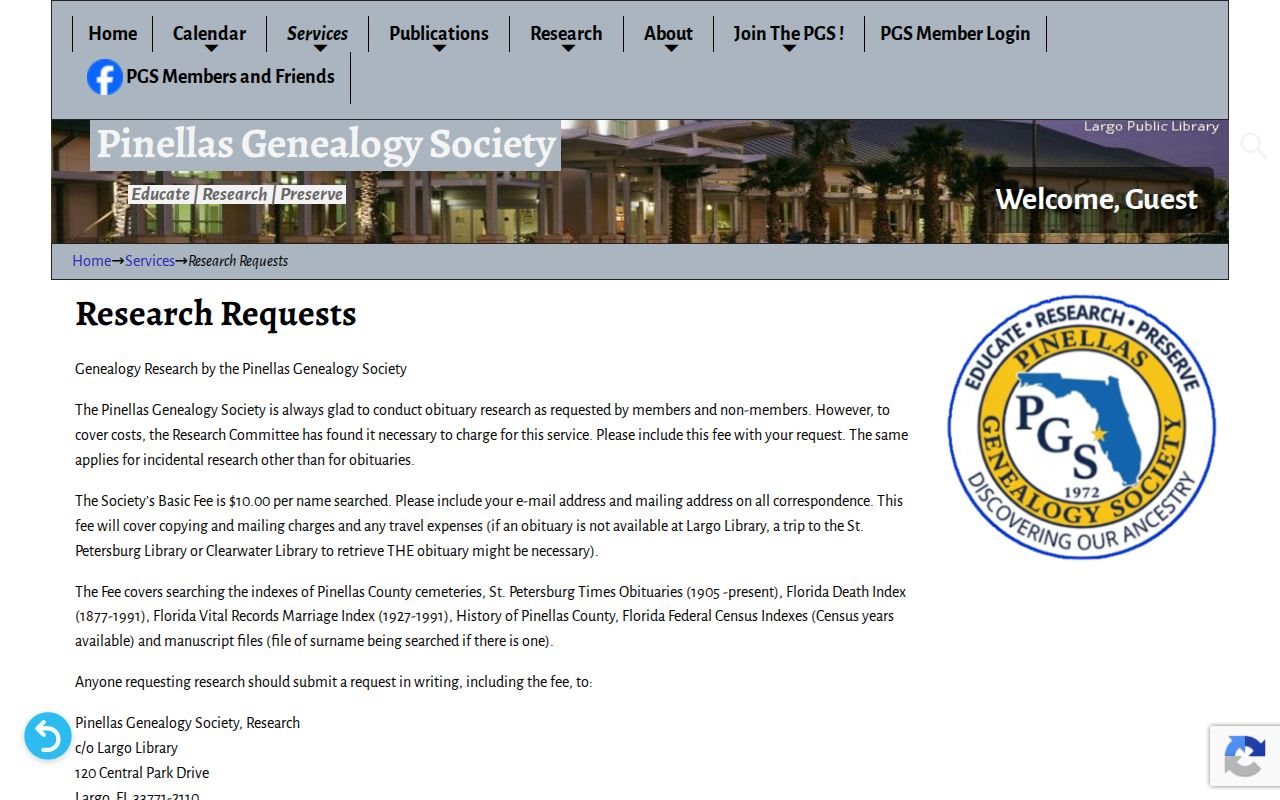
Searches may reach cemetery indexes, a St. Petersburg Times obituary run from 1905 to the present, the Florida Death Index for 1877 through 1991, marriage indexes, census indexes, county histories, and surname manuscripts. The service does not obtain certified certificates. Review the PGS research-request instructions; the captured page below shows the official request entry point.
Largo Past Households
Owners are only one layer. To find previous residents, compare a deed interval with nearby directory and census years. The 1912 regional directory expressly names Largo, while PGS provides a 1910 Largo census extraction. Together they can place a household close to the county's creation. The full collection context belongs on the Largo city directories page; for a house trail, extract only the entries tied to the address and date.
Use a simple flow: deed owner and legal description, then directory address, then census household, then map footprint. If a person disappears, test an obituary, probate case, cemetery index, or funeral-home record. PGS funeral-home extracts can include a spouse, parents, occupation, and burial place. These details may connect a past resident to the next reliable record.
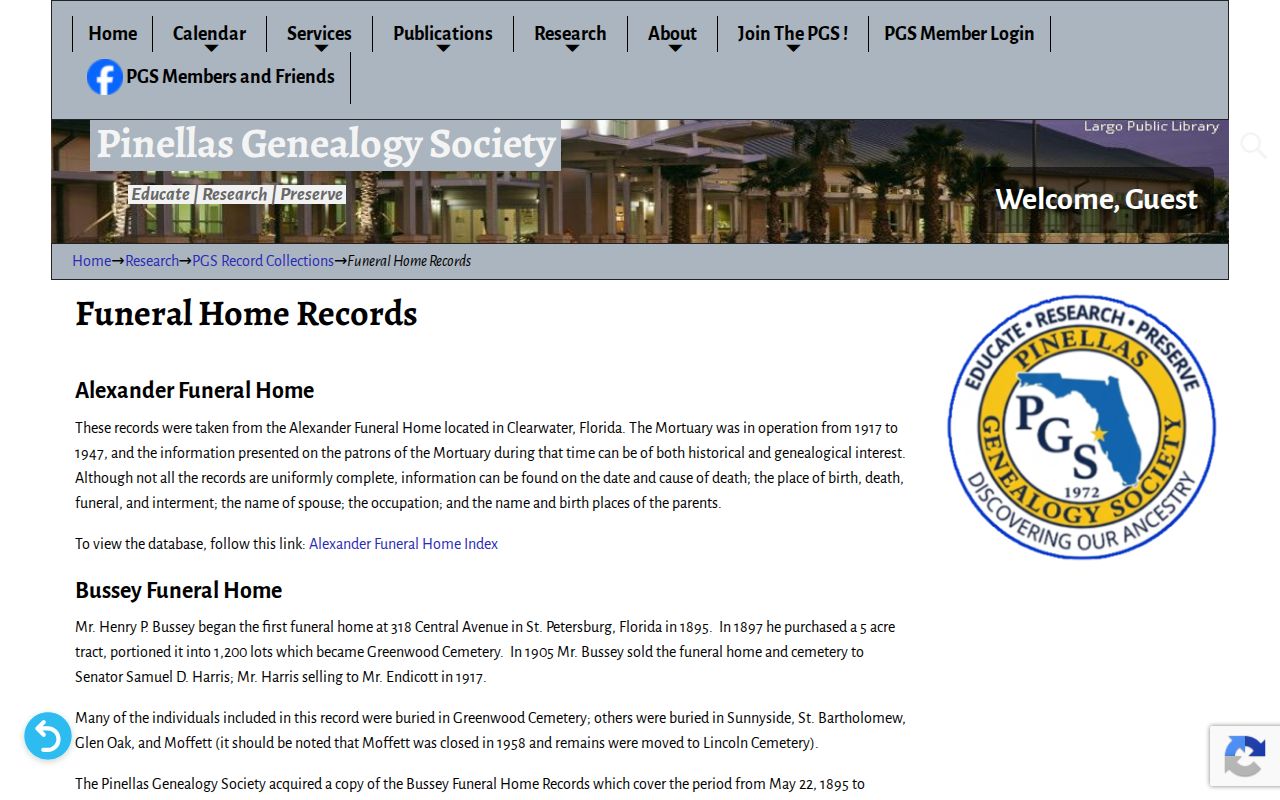
The PGS funeral-home collections include Alexander Funeral Home records for 1917 through 1947 and earlier Bussey extracts. The captured collection page illustrates how such records can close a family trail after an address entry ends.
Lawful use. Research past residents for house history, family history, estate work, or personal curiosity. Never use a record trail to stalk, harass, or harm a living person.